Integrating Deep AI with Plant Disease Diagnosis: Early Detection & Sustainable Protection

- Published on
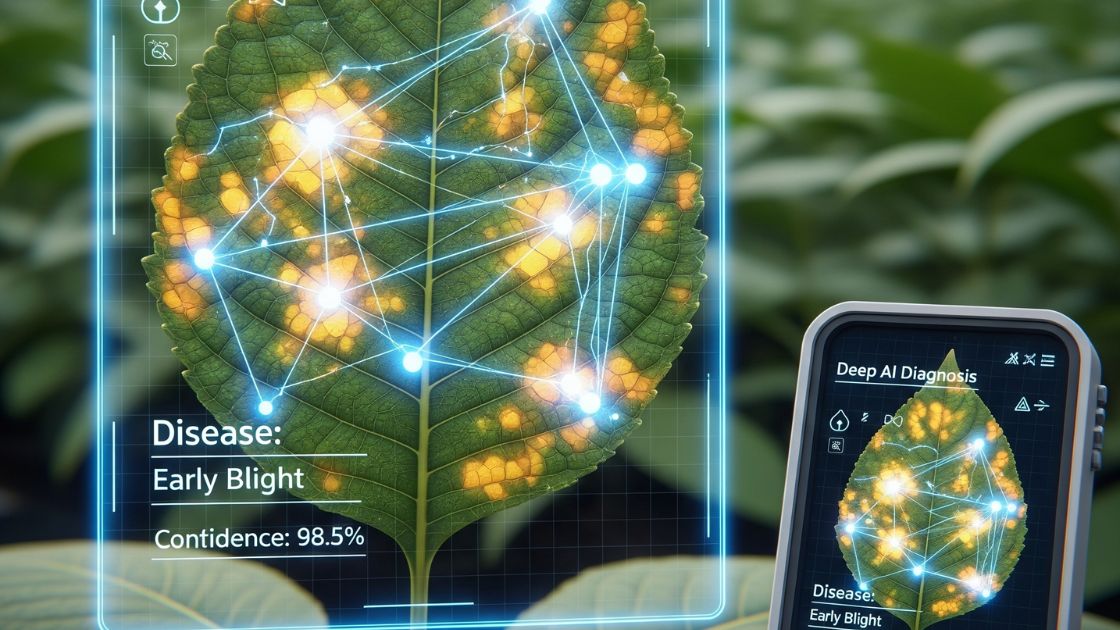
This long‑form article distills the publication “Integrating Deep AI with Plant Disease Diagnosis: Toward Early Detection and Sustainable Crop Protection,” Journal of Scientific Research in Science, Special Issue (Aug 2025). It examines the problem space, methods, results, and real‑world implications for sustainable agriculture.
Why plant disease diagnosis needs AI
Crop diseases threaten food security and farmer livelihoods. Traditional diagnosis requires expert knowledge, lab work, and time — all scarce in the field. Image‑based AI offers:
- Rapid triage: on‑device screening in seconds
- Consistency at scale: standardized decisions across farms/regions
- Lower chemical use: earlier detection → targeted intervention
- Accessibility: deploy on mobile devices and edge hardware
The paper argues that bringing robust, lightweight deep learning to the edge is central to practical impact, aligning with SDG‑2 (Zero Hunger) and SDG‑12 (Responsible Consumption & Production).
Data and task framing
- Dataset: PlantVillage (31,718 training images; 4,514 test images)
- Labels: crop–disease categories from leaf imagery
- Task: multi‑class image classification (diseased/healthy classes across crops)
- Field gap acknowledgment: PlantVillage is lab‑style; the authors discuss generalization challenges to real‑field conditions (lighting, angles, growth stages)
Preprocessing focuses on standard image scaling/normalization suited to mobile inference. The paper calls for more diverse field datasets to close the domain gap.
Model architecture and training setup
- Backbone: MobileNetV2 (depthwise separable convolutions → high accuracy with low compute)
- Optimizer: Adam (β = 0.9, 0.994; ε = 1e‑8)
- Learning rate: 5e‑5
- Loss: Sparse categorical cross‑entropy (integer labels)
- Metrics: Accuracy, Precision, Recall, F1
MobileNetV2 is chosen to balance accuracy with on‑device feasibility (phones/drones/edge). Its compactness makes it suitable for real‑time or near‑real‑time inference in the field.
Results at a glance
- Validation accuracy: 99.4%
- Precision ≈ 0.993, Recall ≈ 0.992, F1 ≈ 0.993
- Training briefly converges within ~10 epochs
These results compare favorably to prior baselines (e.g., ≈97.8% in related work cited), suggesting the chosen architecture and training regime are strong for curated datasets like PlantVillage.
Strengths and comparisons
- Lightweight model, deployment‑friendly: an explicit design goal for field utility
- Competitive performance vs. heavier CNNs on benchmark data
- Literature fit: complements reviews and advances in CNN/GAN‑based diagnosis and data augmentation, acknowledging both promise and gaps
Limitations and open challenges
- Domain shift: lab images → field variability (lighting, occlusions, angles, background clutter)
- Data diversity: need for richer, geographically/seasonally diverse datasets
- Labeling costs: expert annotation is time‑consuming and expensive
- Systems integration: power, connectivity, UX for growers; pipeline robustness at edge
The authors recommend rigorous testing on field datasets and integrating sensors (IoT) and platforms (drones) to gather varied data and enable scalable monitoring.
Sustainability impact
- Early detection reduces yield loss, supporting SDG‑2
- Targeted interventions cut unnecessary pesticide use (SDG‑12)
- Mobile‑edge deployment lowers infrastructure barriers in resource‑constrained regions
Practical blueprint for practitioners
- Start with mobile‑friendly CNNs (e.g., MobileNetV2) and efficient preprocessing
- Use strong yet simple baselines; only add complexity if metrics demand it
- Plan for domain adaptation: augmentation, field data collection, or semi‑supervised/GAN techniques
- Design for edge: optimize model size/latency; consider on‑device or hybrid (edge + cloud) inference
Key takeaways
- MobileNetV2 on PlantVillage achieves 99.4% validation accuracy with balanced precision/recall
- Lightweight architectures enable real‑world use (phones/drones) when paired with robust data practices
- The main frontier is generalization to field conditions; more diverse datasets and on‑site evaluation are essential
Download
- Full text (PDF): Integrating Deep AI with Plant Disease Diagnosis
Suggested citations and related work (from the paper)
- Mohanty et al., Using Deep Learning for Image‑Based Plant Disease Detection (Frontiers in Plant Science, 2016)
- Too et al., Fine‑tuning Deep Models for Plant Disease Identification (Comput. Electron. Agric., 2019)
- Barbedo, Lesion‑level Detection & Factors Influencing Deep Learning for Plant Diseases (Biosystems Engineering, 2018/2019)
- Liu & Wang, Review of DL for Plant Diseases (Plant Methods, 2021)
- Li et al., Unsupervised Representation Learning with GANs for Plant Disease (CCC, 2018)