Smart Tour Guide — AR Information Assistant

- Published on
- Repository
- https://github.com/Abdelraouf-Hawash/Smart_Tour_Guide
- Tech
- Python, OpenCV, MediaPipe, YOLO, Speech, Translation
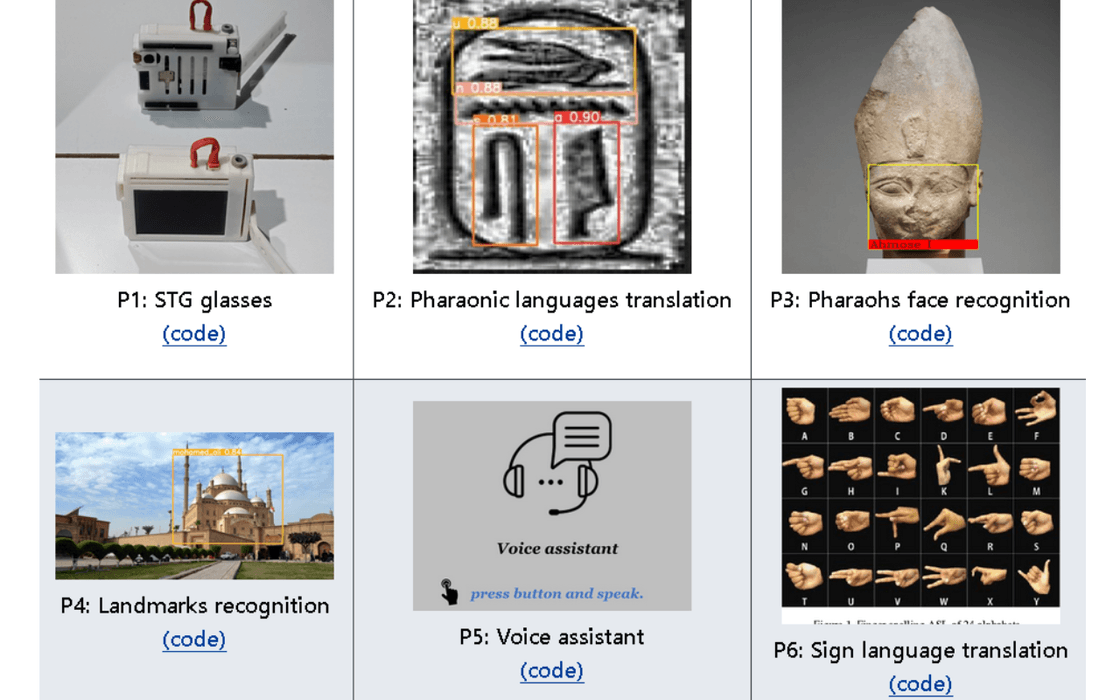
Smart Tour Guide (STG) combines computer vision and voice technologies with a wearable AR experience to deliver on-the-spot knowledge about places and artifacts. The system recognizes landmarks, translates ancient texts, identifies historical figures, and provides an interactive voice assistant — enabling a guided, informative tour without a human guide.
Project structure
- P1 — STG glasses: embedded prototype and hardware integration
- P2 — Pharaonic languages translation: hieroglyphic text understanding/translation
- P3 — Pharaohs face recognition: identity recognition for statues and portraits
- P4 — Landmarks recognition: scene and POI detection/localization
- P5 — Voice assistant: Q&A, weather, and multilingual translation
- P6 — Sign language translation: hand-sign classification for accessibility
P1 — STG glasses (embedded AR glasses)
A hardware-centric prototype of smart glasses built on microcontrollers, providing core on-device capabilities: camera capture, lightweight CV, basic UI feedback, and wireless connectivity.
- Capabilities:
- Camera capture and local inference on MaixDuino/MicroPython class devices
- On-device prompts/alerts; simple display or audio output
- Network connectivity for cloud-assisted tasks
- Tech:
- MaixDuino, MicroPython, embedded CV, basic networking
- Why it matters:
- Establishes the wearable form factor and real-time constraints for user experience
P2 — Pharaonic languages translation (hieroglyphic text)
Translates ancient Egyptian (hieroglyphic) text to modern language. Pipeline includes script region detection, symbol segmentation, sequence modeling, and post-processing.
- Capabilities:
- Detect and segment hieroglyphic glyphs from photos
- Sequence modeling to map glyphs to phonetic/semantic units
- Language translation to readable modern text
- Tech:
- YOLO for detection; custom arrangement/modification algorithms for ordering
- OCR/sequence approaches for symbol-to-text, translation layers
- Why it matters:
- Unlocks context of historical inscriptions directly on-site
P3 — Pharaohs face recognition (historical figure ID)
Identifies kings/queens and notable figures from statue images or portraits to retrieve biographical summaries.
- Capabilities:
- Face detection and alignment on statues/reliefs under challenging conditions
- Face embeddings and classification to known identities
- Info overlay: name, era, achievements
- Tech:
- OpenCV, face_recognition, YOLO-based detection
- Why it matters:
- Turns visual artifacts into interactive, educational experiences
P4 — Landmarks recognition (scene and POI)
Detects and localizes landmarks to provide on-screen overlays with names and facts, allowing context-aware guidance.
- Capabilities:
- Landmark detection in real-world scenes
- Non-maximum suppression for clean overlays
- Overlay of titles, directions, and brief descriptions
- Tech:
- YOLO detectors, NMS, classical CV utilities
- Why it matters:
- Helps visitors orient themselves and discover key points quickly
P5 — Voice assistant (Q&A and translation)
A conversational assistant that answers tourist questions, reports weather, and translates between languages — hands-free and on the go.
- Capabilities:
- Speech-to-text (STT) and text-to-speech (TTS)
- Open-domain Q&A for museum/landmark facts
- Weather and utility skills; language translation
- Tech:
- gTTS, speech_recognition, playsound, openweather API, googletrans, basic NLP
- Why it matters:
- Delivers a natural interface that reduces friction and boosts accessibility
P6 — Sign language translation (accessibility)
Recognizes hand signs that map to characters/words, supporting basic communication for deaf or hard-of-hearing users.
- Capabilities:
- Real-time hand landmark extraction and sign classification
- Spells characters/words; can feed the voice assistant
- Tech:
- MediaPipe Hands, classical ML classifiers
- Why it matters:
- Expands inclusivity for museum and outdoor tour experiences
Integration and UX
- On-device workflows prioritize low latency; heavier models can offload to edge/cloud
- AR overlays complement audio guidance; both adapt to ambient light/noise
- Modular design enables deploying subsets (e.g., only P3 + P4) per venue
Resources
Hi there! Want to support my work?